
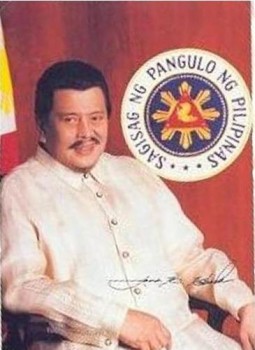
Joseph Marcelo Ejercito Estrada was born on April 19, 1937, in Tondo, Manila. His parents, Engr. Emilio Ejercito and Maria Marcelo, moved to San Juan where he grew up and where he continues to reside to this day. His primary education was obtained at the Jesuit-run Ateneo de Manila University. He later took up an Engineering course at the Mapua Institute of Technology.
In his early twenties, he became a movie actor by accident but later proved himself to be an accomplished thespian, starring in a string of well-received films that earned him the title of a living legend in local filmdom. More popularly known as Erap, he is a five-time Best Actor awardee – a feat he repeated by winning the Best Picture award an equal number of times. This earned him a rare place in the FAMAS Hall of Fame in 1981 and 1984, respectively.
He entered politics in 1967, was elected and re-elected mayor of the Municipality (now City) of San Juan which he served with dedication and distinction for more than 16 continuous years. Unfortunately, he was one of hundreds of local officials who were asked to step down in the aftermath of the 1986 EDSA revolution. When he left his post, the San Juan Municipal treasury registered P24-million in savings.
In 1972, he was selected as one of the Ten Outstanding Young Men (TOYM) in Public Administration by the Philippine Jaycees. He was also voted Outstanding Mayor and foremost Nationalist by the Inter-Provincial Information Service in 1971 and awarded the coveted title, “Most Outstanding Metro Manila Mayor,” the following year by the Philippine Princeton Poll.
His administration of San Juan was marked by unequaled accomplishments in infrastructure development. These included the establishment of the first san Juan Municipal High School, the Agora complex, a modern slaughterhouse, a sprawling Government Center with a post Office, a mini-park and the concreting of 98 percent of San Juan’s roads and alleys.
His administration of San Juan was marked by unequaled accomplishments in infrastructure development. These included the establishment of the first san Juan Municipal High School, the Agora complex, a modern slaughterhouse, a sprawling Government Center with a post Office, a mini-park and the concreting of 98 percent of San Juan’s roads and alleys.
As mayor, he paid particular attention to the elementary education of school-age children by improving and renovating school buildings and constructing additional school structures, health centers, barangay halls and playgrounds in all the barangays and providing artesian wells to areas with low water supply. He relocated some 1,800 squatter families out of San Juan to Taytay, Rizal, at no cost to the affected families. He was also the first mayor to computerize assessment of the Real Estate Tax in the Municipal Assessor’s Office.
For the movie industry, he established the Movie Workers Welfare Foundation (MOWELFUND), Inc. which has now become a robust organization that provides industry workers with financial and professional assistance. His efforts to upgrade and professionalize the film industry have resulted in substantial benefits to all movie personnel, from directors and actors down to the lowest crewmen.
He is the Founder and President of the ERAP Para sa Mahirap Foundation, a foundation that offers scholarship assistance to poor but deserving college students. Through the foundation’s educational grants, more than a thousand students have since earned a college degree.
He also established the San Juan Progress Foundation, the San Juan Police and Fire Trust Fund and the Friends of Joseph Estrada, which offers free burial assistance for the poor folks of San Juan.
In 1987, he set his sights on a Senate run and handily garnered a seat. He was appointed Chairman of the Committee on Public Works. He was Vice-Chairman of the Committees on Health, Natural Resources and Ecology and Urban Planning.
In the Senate, Joseph Ejercito Estrada was credited with the passage of, among other major pieces of legislation, the bills on irrigation project and the protection and propagation of carabaos, the beast of burden in the rural areas.
As a senator, he was one of the so-called “Magnificent 12” who voted to terminate the RP-US Military Bases Agreement leading to the withdrawal of American servicemen from the Clark Air Base in Pampanga and the Subic Naval Base in Zambales.
In 1989, the Free Press cited him as one of the Three Outstanding Senators of the Year. He was conferred the degree of Doctor of Humanities, Honoris Causa by the Bicol University in April 1997, and the University of Pangasinan in 1990.
Joseph Ejercito Estrada, who won as Vice-President in 1992 under a mixed ticket, was also designated as Presidential Adviser on Crime Prevention and Law
Enforcement with a Cabinet rank and served concurrently as Chairman of the Presidential Anti-Crime Commission (PACC). AS PACC chairman, he was a member of the National Security Council.
The notable accomplishments of the PACC against kidnappers and bank robbers, together with “hoodlums in uniform,” “hoodlums in robes” and illegal recruiters, earned for Chairman Estrada a performance rating of 85 percent in public opinion polls.
He funded the Philippine Drug Abuse Resistance Education (PhilDARE) Program on August 24, 1993, to address the growing problem of drug abuse among the youth.
His role in establishing peace and order, however, was cut short by the issuance of Executive Order No. 221 in January 1995, which clipped the PACC’s operational control over its task forces. He resigned as PACC chairman on June 4, 1997.
He reached the pinnacle of his political career when he was elected President of the Republic in the May 11, 1998 national elections. With almost 11-million Filipinos writing his name on the ballot, his margin of victory was the biggest ever registered in Philippine electoral history.
Speaking before millions gathered at his inaugural address in Manila, the newly-elected chief executive said his presidency would serve the Filipino masses whose welfare had long been neglected. A line from his speech, “Walang kaibigan, walang kumpare, walang kamag-anak,” was a stern warning against anyone who would attempt to undermine his administration with influence-peddling.
Determined to bring his pro-poor platform to every facet of the government’s operations, he immediately ordered the removal of all sovereign guarantees on contracts for public projects which would require the sovereign Filipino people to assume the financial losses of private companies doing business with the government. Records will show that until January 20, 2001, he did not sign a single government contract with a sovereign guarantee.
Committed to cleaning the bureaucracy of undesirable elements, he ordered the immediate relief of corrupt officials in the military and police hierarchy. He ordered a wide-ranging investigation of all government contracts entered into by the previous administration to ensure these were above-board and directly advantageous to the citizenry.
He ordered the investigation of suspected big-time tax evaders even if some of these individuals had contributed to his presidential campaign.
His pro-poor program of government bore fruit in less than two years, with a significant improvement in the country’s peace and order situation. This likewise elicited a proportionate rise in the approval rating of the Philippine National Police.
The Estrada administration undertook an aggressive housing program on a national basis, targeting low-cost homes for the poor.
Agriculture received greater priority, while the national government likewise took steps to bring down the cost of medicine.
Foreign investments grew exponentially, benefiting greatly from the unsullied and esteemed reputation of the best and the brightest chosen to be part of his Cabinet, and even more from his reputation as a strongly nationalistic yet progressive president.
Tragically, a cabal of disgruntled businessmen dissatisfied with his pro-poor stance joined forces with elitist members of civil society and a number of high-ranking Catholic priests to put in motion a movement to steal his presidency by first destroying his reputation and employing a false witness with a dubious character and shadowy background to spearhead this.
The Senate impeachment trial, a constitutional process initiated to determine the truth behind the allegations of corruption hurled by the false witness, ended abruptly in mid-January 2001 when prosecutors staged a walk-out after senators voted against the opening of a document which had no bearing whatsoever on the cases filed before the tribunal.
With the second highest official of the land and her husband working secretly with this group and courting the military sector’s support, things came to a head on the 20th of January 2001 with the leave of absence filed by Joseph Estrada and his temporary departure from Malacanang.
Following the Supreme Court’s decision upholding the legality of the Macapagal-Arroyo presidency, he was arrested at his San Juan home in the afternoon of April 25, 2001 on the strength of a warrant of arrest issued by the Sandiganbayan for the crime of plunder filed by his political enemies.
The painfully humiliating nature of his arrest sparked massive indignation from his millions of supporters, many of whom converged at the EDSA Shrine to demand his release and reinstatement. On the eve of May 1, 2001, a fraction of the estimated three-million who gathered in EDSA marched to Malacanang to bring their case before Mrs. Arroyo but were met with brutal police and military force.
A long-drawn out trial before the Sandiganbayan special division gave his defense panel the opportunity to map out in unequivocal terms the inconsistencies and impossibilities inherent in the plunder charges filed against him, primarily on the strength of the false witness’s testimony.
In candid moments, however, he acknowledged the improbability of obtaining a fair verdict from a “kangaroo court” which was widely believed to have been created for the sole purpose of ensuring his conviction.
His incarceration continued for more than six years, with only his place of detention changing: the Veterans Memorial Medical Center, Camp Capinpin in Tanay, and finally at his Tanay rest house where he remained until he was freed in October 25, 2007 on the strength of an unconditional pardon.
Today, Joseph Estrada – the private citizen – spends most of his hours making up for lost time by visiting urban poor neighborhoods in what he calls a “Lakbay Pasasalamat” (thanksgiving caravan) to thank residents for their unstinting support for him despite being away for so long.
From June to July of 2008, Estrada’s civic calendar had him bringing humanitarian and relief missions to several provinces severely affected by torrential rains and floods spawned by typhoon Frank. Together with well-meaning friends and associates, Estrada toured devastated barangays and communities in the Panay peninsula – including Iloilo, Aklan, and more recently Romblon – to distribute relief packs of rice, medicines, and canned goods. His visits included meetings with local officials to determine how best to assist these communities in the long-haul goal of rising from the ruins.
He is likewise picking up where his other pro-poor programs and anti-hunger advocacies left off, calling for greater public support for initiatives that can uplift the lives of millions of Filipinos living in sub-human conditions, at a time when successive fuel price increases and the rice price crisis threaten their survival.
Known to many as Erap, he is married to former Senator Dr. Luisa Pimentel by whom he has three children, namely Jinggoy, who is now a senator of the realm, Jacqueline and Jude.

